Blog
Traditional Iranian Painting

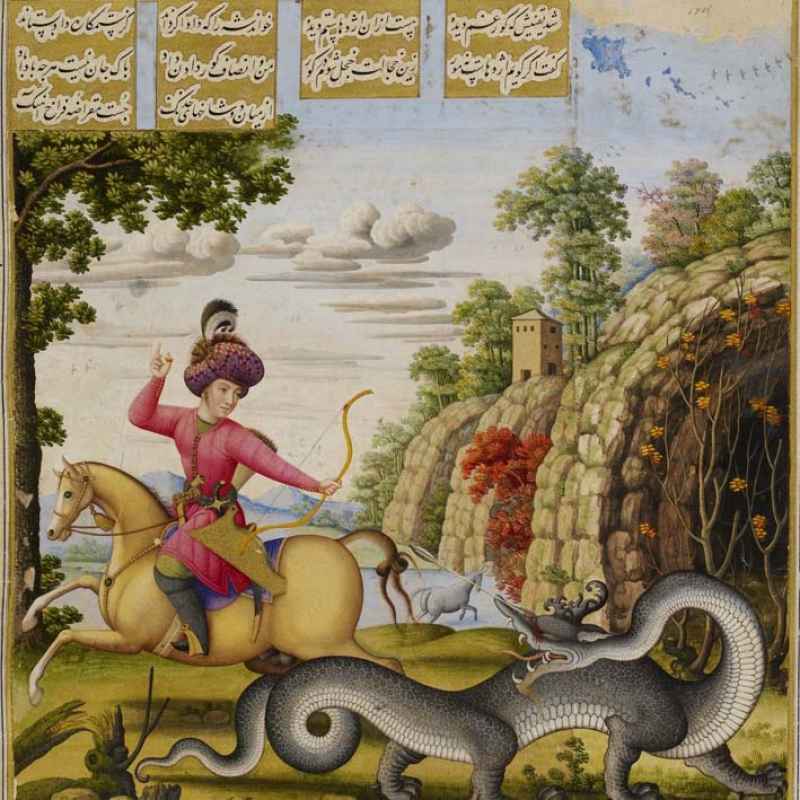
Traditional painting handicrafts are considered one of the art forms that can serve as a tool for conveying messages, themes, and various narratives. Due to their beautiful patterns, designs, and colors, traditional paintings have the ability to captivate the audience and immerse them in the story or concept depicted in the artwork.
In this article, we aim to introduce you to traditional painting handicrafts and explore their various types.
Every nation has its own stories and events—national, epic, religious, and more—that are shared with the community. Traditional painting has been used as a special medium to convey these stories. The patterns and designs, created with unique and vibrant colors for decorative or practical purposes on different surfaces, are referred to as traditional painting handicrafts, or in other words, traditional design and painting.
Traditional design and painting consist of elements such as design, pattern, and color. Artists consider each of these components carefully at every stage of creating a traditional painting artwork.
Types of Traditional Painting Art in Iran
1. Traditional Design
This involves creating various beautiful and distinctive motifs that are applied in linear forms within traditional design and painting.
Traditional design is used in all types of handicrafts and can be applied to both flat and curved surfaces.
The main tools used in traditional design include various pencils, brushes, measuring instruments, paper, and more.
When applying traditional design, artists create patterns that are both aesthetically pleasing and appropriate for the subject of their work. These designs are then transferred onto the artwork and, finally, painted with color.
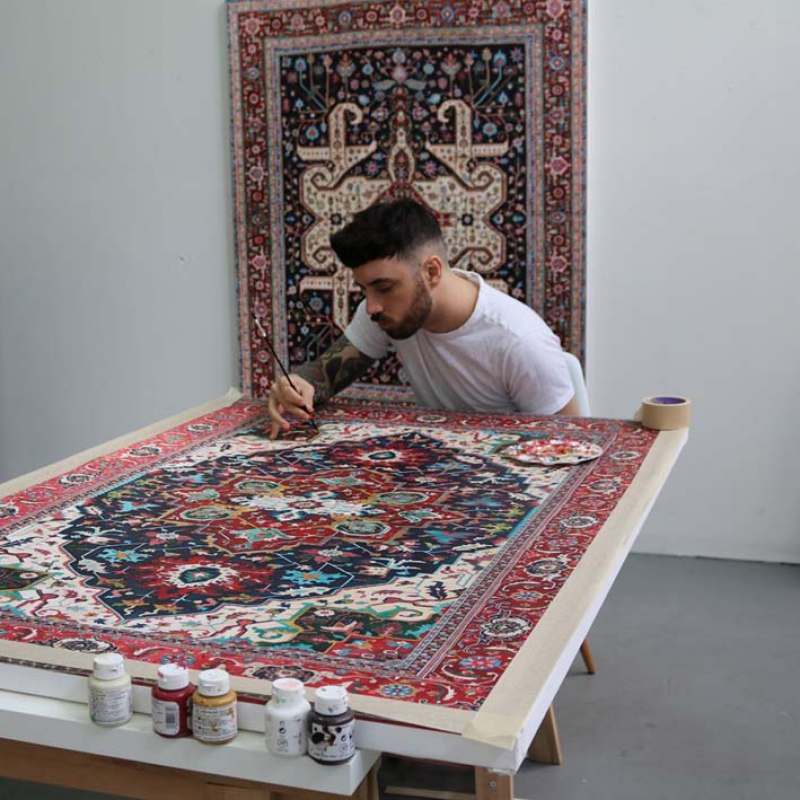
The Role of Traditional Painting in Handwoven Carpet Design
2- Traditional Miniature Painting
The art of miniature painting, known as Negarkari in Persian, refers to any activity such as coloring, shading, designing, and outlining with the aim of creating beautiful and functional illustrations on various subjects.
The miniature artwork ‘The Meeting of Two Kings’ (Negarkari) is an example of traditional Persian painting.
Originally, miniature painting was primarily used in wall murals and manuscript illumination. Today, it is more commonly applied to artworks such as paintings and decorative panels.
Miniature art can be executed on a wide range of surfaces, including flat surfaces, walls, tiles, canvas panels, glazed pottery, enamel dishes, and more.
The tools and materials used in miniature painting include various brushes, pencils, rulers, set squares, compasses, palettes, color containers, beads, inks, gums, paper, cardboard, plywood, gold leaf, black ink, and a variety of pigments.
In miniature painting, the artist freely engages in imaginative creation across diverse themes. The artist’s imagination often goes beyond reality, drawing upon personal knowledge, memories, and aspirations to enrich the artwork.
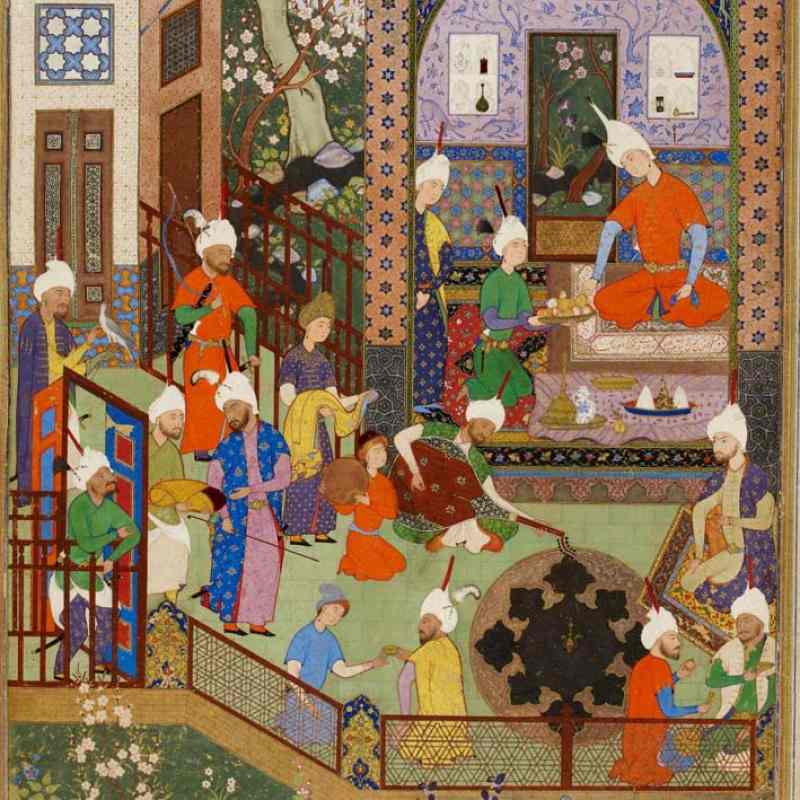
A depiction of the Royal Celebration as an example of traditional painting.
3. Tazhib (Illumination)
Blue Tazhib as an Example of Traditional Painting
Tazhib, or illumination, refers to the gilding and gold-leaf decoration of regular geometric motifs, often accompanied by fine black lines and adorned with gold water, along with the use of various other colors. In tazhib, artists apply design, coloring, delicate outlining, and gold embellishment to create intricate patterns on different surfaces.
The colors used in tazhib traditionally include vermilion, lapis lazuli, white, saffron, verdigris, and others.
Tazhib is commonly used to decorate the borders of book pages, margins of calligraphy pieces, headings, and more.
This art can be applied to both flat and convex surfaces, such as enameled vessels and seven-color tiles. The designs often feature plant motifs (such as Islimi and Khatai), human figures, geometric patterns (knots), or combinations of these elements.
The tools and materials required for tazhib include pencils, brushes, compasses, set squares, water and color containers, palettes, various pigments, gum, parchment, cardboard, plywood, gold leaf, black ink, and more.

